‘Escape To Venice’ by Lindsay Pellow
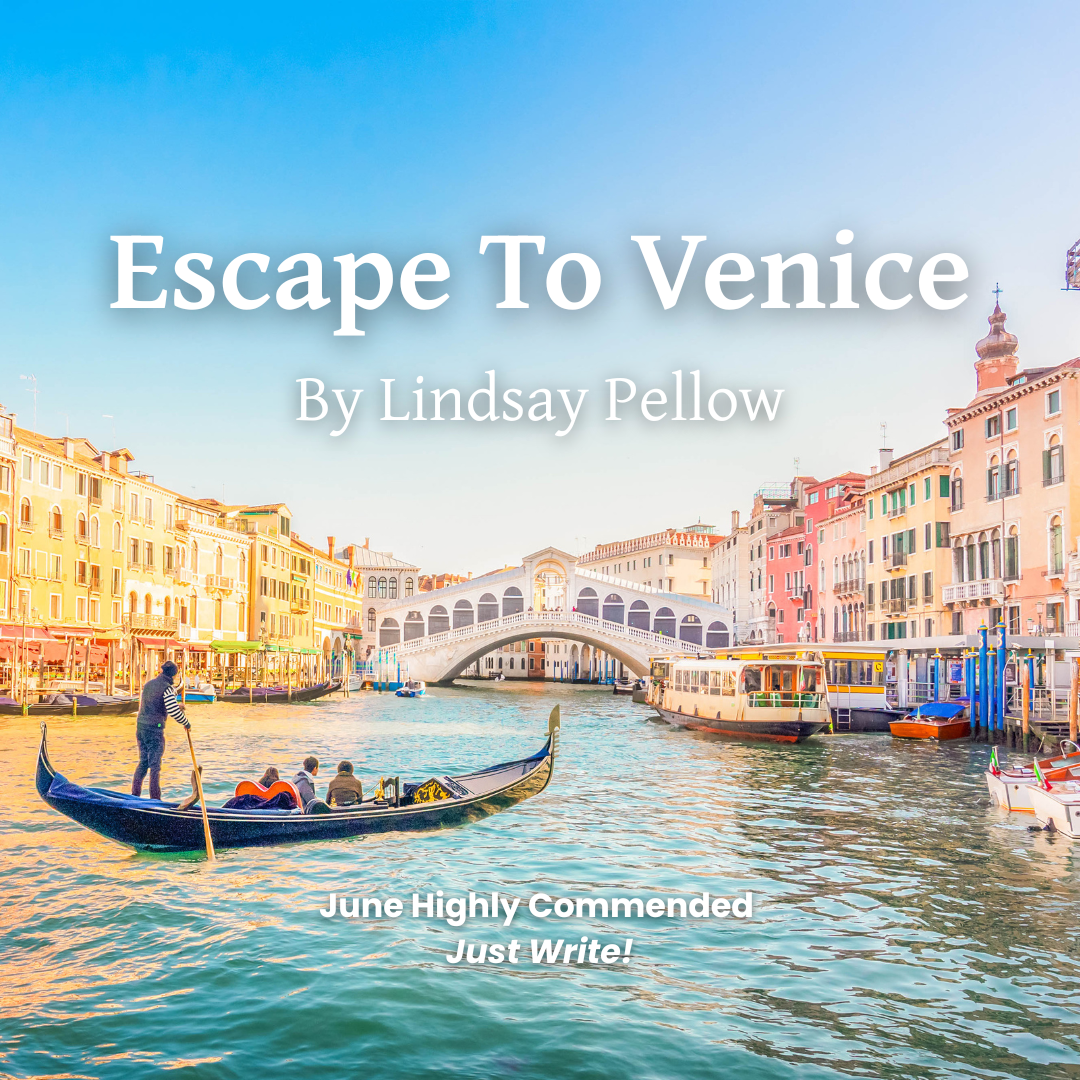
Leaving the evocative smells of the market behind and crossing the busy Rialto Bridge, Rachel paused to take it all in. The ancient stone bridge groaned with people. Tourists stopping to take selfies over the Grand Canal, a huge walking tour, probably American, following an orange umbrella whilst fiddling with their headsets, and the locals, some trying harder than others to hide their frustration at the slow-moving crowd.
How many people have stood in this spot over the hundreds of years since the bridge was constructed to connect San Marco and San Polo, she thought to herself, and what would those early Venetians think of a bridge built for such a practical purpose as crossing the water being such a tourist attraction? Content to muse to herself, she pondered how many millions of pairs of feet have stood in the exact spot she was now.
Solo travel felt empowering. No pressure to chat, no need to plan every day’s activities – what to do, where and when to eat, no need to compromise on what to do next to keep everyone happy. In fact, no need to decide anything much at all. If she were in a group, there would be sure to be a debate to determine how many people have ever crossed the Rialto Bridge, no doubt including several Google searches and an eventual agreement to disagree.
For the first time in what felt like years, Rachel could please herself, and until she was in the water taxi speeding across the lagoon with the wind in her hair and Marco Polo Airport fading into the rear distance, she hadn’t realised how much she needed it. Not to be the organiser, not to be the conduit through which every family decision seemed to need to pass, no matter how big or small.
Smiling to herself as she was carried off the bridge by the unrelenting throng, Rachel took the first side road she could find and headed toward her hotel in Cannaregio, quietly congratulating herself for choosing one of Venice’s quieter regions. Crossing Campo del Ghetto Nuovo and remembering the classic tourist tip phrase “look up, so you don’t miss anything,” Rachel studied the tops of the decaying but still beautiful buildings, missing stucco revealing the soft pink plaster underneath. A woman’s mournful face looked back at her from the far corner, turning her blood cold. The palazzo looked derelict, with gaps where windows and shutters once protected its occupants from the unforgiving afternoon sun. As she continued to watch, Rachel felt the woman’s pleading stare.
With no one around, Rachel hurried on to her hotel. Telling herself she must be imagining things, she determined to put it out of her mind, though during a failed siesta attempt she found her mind wandering back to the woman. What was she doing there? Did she need help?
Feeling better after a shower, she dined at a small osteria, feeling the anonymity of solo dining by listening, if not understanding, to the conversations of nearby tables with their mixture of Italian, English, and other languages she couldn’t place. Strolling back to her hotel, she found herself once more crossing the same campo and looking up. The face was still there, gazing wistfully at her. Alarmed, Rachel hurried back to her hotel, telling the bemused night manager what she had seen and asking him what he knew about the palazzo. It had been unoccupied for over twenty years, he explained, gently suggesting it wouldn’t have been possible for her to see a person there. It was hoped someone would soon buy it and bring it back to life. Realising he must think her a neurotic middle-aged Englishwoman, she hesitated before once again emphatically insisting a woman needed help.
Sighing gently, he said, “Look, my nephew is Il Carabiniere, a police officer. I will ask him to take a look.” Pacified, Rachel went to her room and to bed, though it took her hours to drift off; not that this was unusual, she often struggled to get to sleep at home, her thoughts racing on her never-ending to-do list.
The following day, Rachel found she had slept in, and when she went down to the lobby, the night manager had long left. Heading back to the same palazzo, she looked up but couldn’t see the woman. Had she imagined it all?
Her afternoon passed slowly with a visit to Chiesa della Madonna dell’Orto, or Tintoretto’s Church as her guidebook proclaimed it to be, essentially a gallery of his work. The enormity and splendour of the towering canvases of The Last Judgement and The Adoration of the Golden Calf, with their swirling storm of biblical figures, made Rachel feel small and almost light-headed as she reflected on her own life and purpose, and aware of the tension she carried in her shoulders, she felt a sudden urge to weep.
Gathering herself and wandering along the canals and back streets, she felt calmer but found the woman kept entering her thoughts. Returning to the derelict palazzo. Rachel nervously looked up, and once more the face returned her sad gaze.
Feeling a weight come over her, Rachel returned to her hotel and sipped espresso in the bar as she waited anxiously for the night manager to start his shift. At last, he appeared and, seeing her, he approached.
His nephew had been to the palazzo, he explained, and there was no sign of any person there or having been there recently. The only things in the top floor she had described were some old items of furniture, a table, a broken chaise, and a mirror. Taking the seat next to her and touching her arm kindly, he asked gently, “Could the woman you saw have been you?”
Lindsay Pellow wrote this story in response to the prompt Look Up, as part of June’s Just Write! short story competition.
