The shape of storytelling
As a writer, how often do you think of the shape of a story?
I’ve been reading some wonderfully creative and imaginative pieces this week, courtesy of the entrants to Just Write!. One of the things that stuck out in a few of the pieces was their shape. Not literally - though stay tuned for another instalment on paragraph structure in the near future. I’m talking about the metaphorical shape of storytelling.
I’m sure you’ve probably heard the term ‘arc’ used when referencing stories. Perhaps as a story arc, or a character arc. Well, the arc is an important construct to keep in mind while writing because it gives your work shape.
What is a story arc?
We’re all taught that every story has a beginning, a middle, and an end. If you think of it like crossing a bridge, you begin on one side, you cross the bridge, and then you end up in a different place. A bridge is a great example here because the journey to cross it demonstrates exactly what an arc does - it creates change. In this case, you end up somewhere different than where you started.
Not all arcs transport you physically.
Some arcs focus on character development - your hero discovering or changing something about themselves over the course of their journey and ending the story as a different person (again, not literally, but deep down).
Some arcs affect the world. The hero’s actions throughout their journey change the way it functions.
Others are more literal, where, like the bridge example, a hero ends up reaching a destination they’d set out to.
The common denominator is that every story needs change in some way.
When writing a short story, something I’ve noticed is that many writers have a tendency to forget, or feel there’s not enough space to create change. So they decide to forgo it.
But that’s to their detriment.
How a story arc holds together
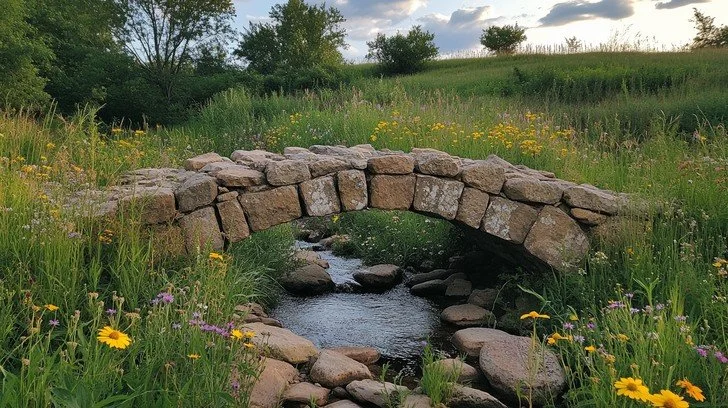
There’s a particular kind of old stone bridge that holds together with no mortar at all, just stone wedged against stone. What holds that structure up isn’t the stones themselves; it’s physics. The friction and tension between each stone. Each one puts enough pressure on its neighbours so that none can move independently, and the bridge never collapses.
But remove one stone, and you remove that pressure. Lay the stones out flat next to each other instead of against each other in a curve, and you suddenly don’t have a bridge anymore. You just have stones.
In the same way, if you remove the middle of your story where the pressure is built, you don’t have a story… you just have words.
Change takes time and pressure
Now, I hate to layer and jump between metaphors, but I’m going to do it anyway. Because if the bridge wasn’t clear enough as an example, a diamond certainly should be.
A diamond is formed when pressure and heat get forced onto carbon over a long stretch of time, until what comes out the other end is something different to what went in. It's not one event that does it; it's the combination of those two things.
That's your middle. Conflict is the pressure, the events of your story are the heat, and time on the page is what lets the two of them shift things along.
It doesn’t matter if you’re writing a novel, a script, or a short story; without that middle portion that creates change, a story can have a beginning and an end, each one perfectly written, but the reader will remain stuck in the same place throughout.
Writing an arc into a short story
In a short story, like the ones Just Write! entrants are tasked with, this can feel harder to execute because there’s less room to build the arc. But change doesn’t need to be huge to count. It might be a character who’s spent the whole story avoiding a phone call, finally picking it up, even if we never hear what’s said. Or someone who’s been certain about something small, the way they take their tea, the route they always walk home, making a different choice in the last line - enough to tell you something’s shifted in them that the story never states outright.
The simplest of lines can demonstrate the biggest of changes, and can prop up the entire arc on their own. Even if you’re limited on word count, it’s still possible to build your bridge.
If you’re working on something right now, I’d encourage you to think about its shape. Whether you have a draft or you’ve got an idea mapped out, look at the start and look at the end and ask yourself - what’s changed?
