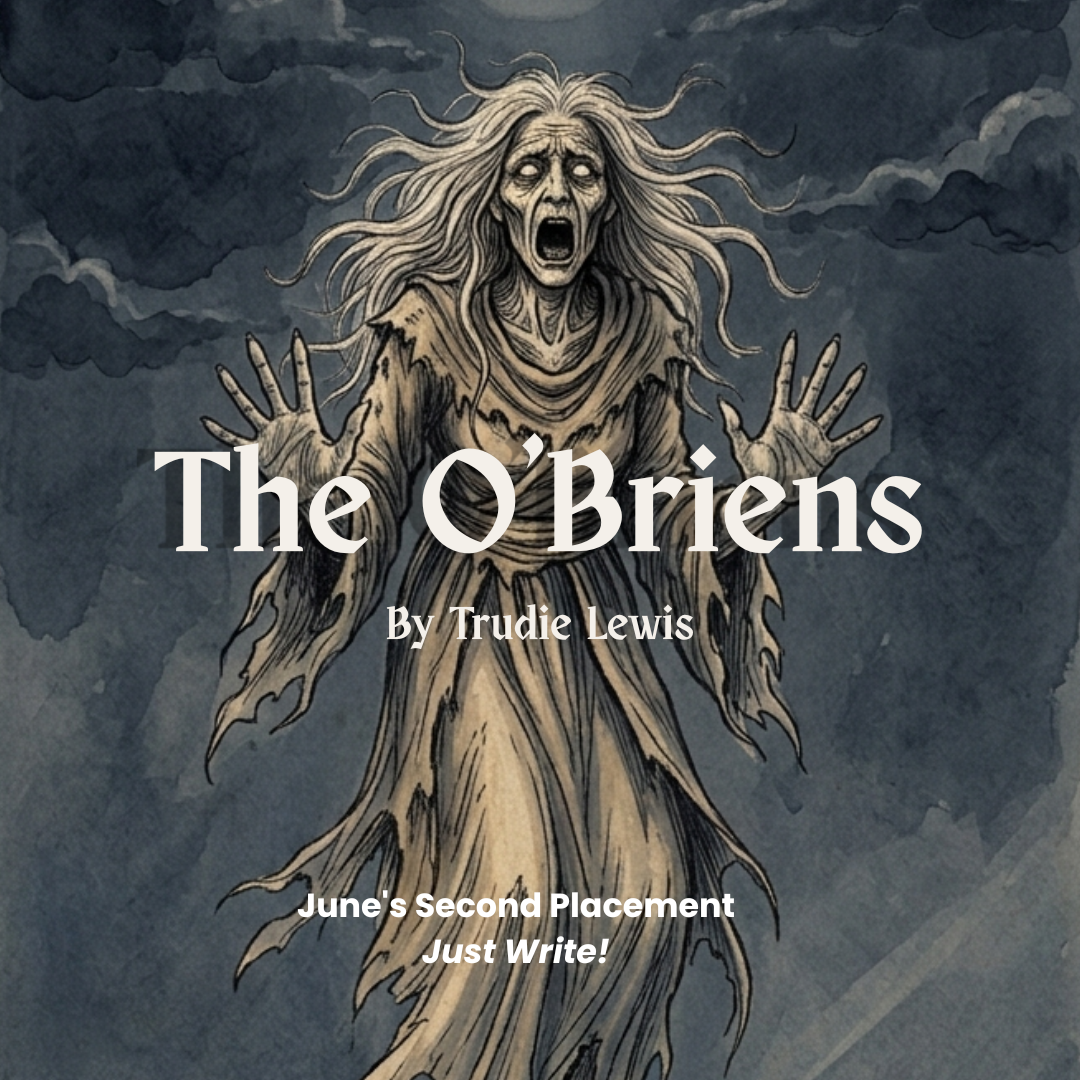
I. The Banshee
Orlaith awakens after years of torpor. It’s 2026, and there hasn’t been a traumatic O’Brien death for generations. But now the compass inside her twitches, oscillates, and her form becomes corporeal once more. Rising from the mound where she slept, she surveys the ruined castle that was once familiar. The urge to warn Padraig O’Brien compels her, as it has compelled her for every member of his clan.
Still disoriented, she seeks help from the nearby fae, trying to keep her mournful song from turning into a lament for herself. A Púca is her first stop. Mischievous and unreliable, yet somehow effective, it locates Padraig in a plush care home outside Dublin. How it knows, she cannot guess, but she is grateful.
She begins her chant beneath his window. Days pass. Nothing happens. Padraig does not react, though she senses him inside, and no family appears. If she cannot complete her duty, she is lost.
She turns to other fae. Mim, a Selkie, who transforms into a care worker and looks-up Padraig’s records. They learn his hearing has failed and he has no listed next of kin. At least Orlaith knows why he cannot hear her cries, but where are the O’Briens?
She keeps singing. It is all she can do.
Kevan of the Sídhe, master of glamour, suggests she use Instagram to find them. She has already drawn crowds: people stopping, listening, crying, convinced they’re witnessing the world’s most talented busker. Her Instagram launch is an instant success. Thousands of views. There are endless debates about whether she’s levitating, or it’s an AI trick. Arguments over whether her eyes are green or gold, and how can her hair be blowing in different directions at once. And the language — non-Irish listeners insist it’s Gaelic; Gaelic speakers swear it’s Cornish or Breton. She is, undeniably, viral.
Orlaith knows, deep in her being, that once the O’Briens hear the call, they will understand. Her service will be complete.
II. The O’Briens
The first to hear her is Mia, the youngest and farthest away, living alone in Brisbane after her mother’s death from ovarian cancer a few years ago. When Orlaith’s video appears on her feed, it halts her doomscrolling. She watches it repeatedly, headphones, speakers, TV, every which way she can so be sure that she is hearing the message. No, not a message, an instruction. A command.
“Come home. Death is coming. Come home.”
And “home” feels like Éire.
Mia knows she and her mother were born in Ireland before emigrating to Australia when she was a baby. Her mother never spoke of family, and Mia always sensed the story was painful. With no one to ask, she posts her interpretation on a subreddit, hoping someone can advise her.
Cooper, legally a Larkin now, sees the video when his girlfriend sends it to him. He becomes obsessed, replaying it endlessly, the melody burrowing into his thoughts like something that must be touched even though it hurts. After days of this, he posts his own video begging Orlaith to contact him.
Elsie, the oldest living O’Brien besides Padraig, never sees the viral clip. She only uses Facebook. But a “23 & Me” kit gifted for her 50th birthday revealed a connection to her beloved cousin, the one who died twenty years ago. The connection was to a man in New York named Cooper. She knows her cousin was forced to give up his child and was broken by it. From her tiny Bristol terrace, Elsie emails Cooper, telling him about his father.
Mason, the last O’Brien, is a linguistics academic in Toronto. He’s invited onto TV to discuss the viral video, but on first viewing becomes disoriented and panics live on air, ending his brief TV career. When calm and alone , he falls down an online rabbit hole. He finds Mia’s subreddit post, notes their shared surname. He watches Cooper’s plea, — something he would normally dismiss as millennial theatrics, yet this time it moves him to tears. He has never met them, but he knows them. They hear what he hears.
He finds Elsie’s number and calls her.
III. Dublin
Mia flies to Heathrow, where Elsie collects her. They take the long route to Dublin, trains and ferries, and by the time they arrive, they know everything.
Mason meets Cooper at JFK, and they fly together. They decipher the message and understand the call is about Padraig. Slowly and thoughtfully, they piece together who Padraig is to each of them.
They gather at the care home in Padraig’s room, who watched them, glassy-eyed, not fully comprehending who they are.
Elsie and Mason fill in the gaps. Mia’s mother had been exiled by Padraig for daring to have a child out of wedlock. Cooper’s mother had taken her own life after being ostracised by Padraig, leaving Cooper’s father mentally exhausted, forcing him to have his beloved child adopted. Elsie lost both cousins, her childhood companions, to Padraig’s cruelty. Then she had lost Mason too, when he was disowned for being gay and fled to Toronto to live freely.
Elsie was the last to leave Ireland, the only “acceptable” O’Brien in Padraig’s eyes. The power he held over her parents was poisonous and hollow. She escaped to breathe clean air again.
They all turned to look at Padraig.
IV. Orlaith
Orlaith rises to the window, watching the gathered O’Briens. Her chant grows louder, her hair whipping around her as she rattles the shutters.
Then she screams.
Her scream twists into a high, nasal dirge, punctuated by bursts of weeping. And she wails her witness to Padraig O’Brien’s tragic death, the kind she was born to herald.
Trudie Lewis wrote this story in response to the prompt Look Up, as part of July’s Just Write! short story competition.
